Every January, and again every September, my calendar fills with the same request: please teach me how to meal prep. A client sits down across from me, sighs, and says some version of, “I know what to eat. I just never have it ready.” They have tried the Sunday marathon. They have even bought the matching glass containers. Still, by Wednesday they are standing in front of an open fridge at 8 p.m., eating crackers over the sink.
I have worked as a Registered Dietitian Nutritionist for a long time now, and the problem is almost never knowledge. In fact, it is logistics. So when people come to me for help, I don’t hand them a list of recipes. Instead, I hand them a timeline, a short shopping system, and permission to stop treating Sunday like a cooking competition.
This is the exact meal prep approach I teach in my practice and use in my own kitchen. It takes under two hours, it produces food you will actually want to eat on Thursday, and it respects the food safety limits that most social media videos quietly ignore.
Why Two Hours Is the Right Meal Prep Target
Most beginners overshoot. For example, they plan five different recipes, each with its own cutting board, pan, and cleanup. As a result, four hours later they are exhausted and swear never to do it again.
Two hours is long enough to cook the foundation of a week and short enough that you will repeat it. In other words, consistency beats ambition here. A modest prep you do 40 weeks a year will do more for your health than a heroic prep you do twice. If starting new routines tends to stall for you, these tips on how to stop procrastinating can help you get that first session on the calendar.
What the Research Says About Meal Planning
There is also real evidence that planning itself matters. A large French study in the International Journal of Behavioral Nutrition and Physical Activity looked at 40,554 adults in the NutriNet-Santé cohort. Roughly 57 percent said they planned meals at least occasionally, and those planners were more likely to meet nutrition guidelines and eat a wider variety of foods. In addition, women who planned had lower odds of overweight and obesity, and men who planned had lower odds of obesity.
The researchers were careful to say the study can’t prove cause and effect, and I agree with that caution. Still, it matches what I see in clinic: people who decide what they will eat before they get hungry tend to eat better.
Similarly, Harvard Health recommends setting modest goals, such as planning a home-cooked meal twice a week if you currently rely on takeout most days. In short, start small and build.
The Meal Prep Mindset Shift: Prep Components, Not Meals
Here is the single biggest change I ask clients to make. Stop prepping finished meals. Instead, prep components.
When you cook five identical containers of chicken, rice, and broccoli, you have made one meal and committed to eating it five times. Consequently, by day three your enthusiasm is gone and the delivery app starts calling your name.
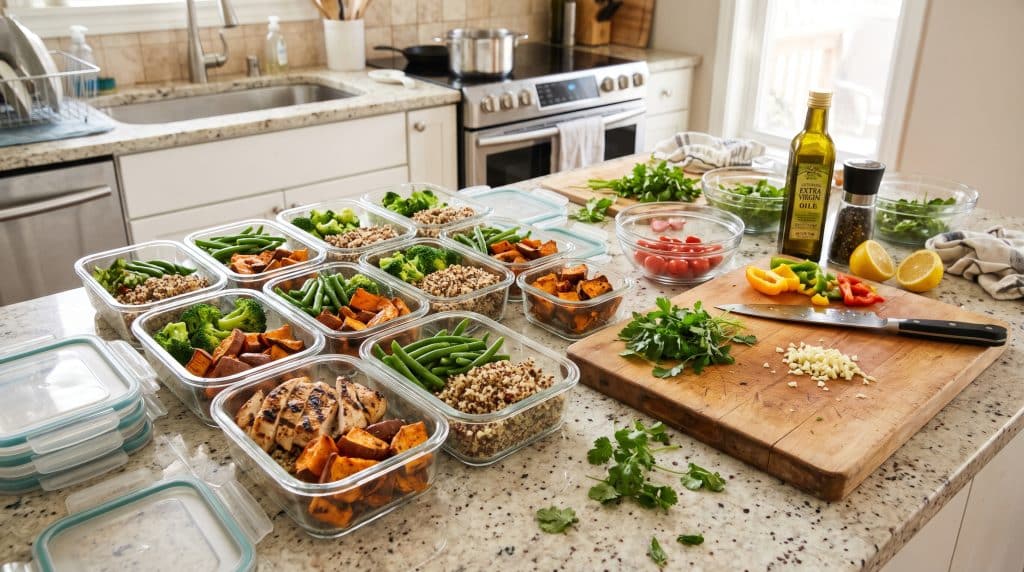
When you prep components, you cook a few proteins, a couple of grains or starches, a tray or two of vegetables, and one or two sauces. Then each day you assemble them differently. For example, Monday is a grain bowl. Tuesday, the same chicken goes into a wrap with crunchy slaw. Wednesday, it becomes a quick fried rice. It’s the same two hours of work but a very different eating experience.
My Working Meal Prep Formula
- Two proteins: one animal and one plant if you eat both, or two plant proteins if you don’t.
- Two starches or grains: ideally one whole grain and one starchy vegetable.
- Vegetables cooked two ways: one roasted and one raw or quick pickled.
- One or two sauces that tie everything together.
- A breakfast and a snack you can grab without thinking.
That is it. It sounds like a lot, but almost all of it cooks at the same time.
Before the Clock Starts: Your 15-Minute Meal Prep Plan
The two hours do not include planning, and planning is where most people get stuck. For that reason, I keep it to 15 minutes, usually on Friday evening or Saturday morning.
Look at your week first, not your recipes. Do you have a late meeting Tuesday? A kid’s game Thursday? A dinner out Friday? Count how many meals you actually need to cover. Most people discover they need far fewer than they thought. If you are eating out twice and having leftovers once, your prep might only need to cover lunches and three dinners.
Pick a flavor direction. One loose theme for the week makes shopping easier and keeps sauces from clashing. One week might lean Mediterranean with lemon, garlic, herbs, and a yogurt sauce. Another might lean toward ginger, soy, sesame, and lime. This also stops you from buying ten spices you will use once.
Shop Smarter, Not Longer
Check what you already have. Open the freezer and look in the pantry. That half bag of farro and the frozen shrimp count. Building around what you own cuts both cost and waste, which also makes it easier to create a budget you can actually stick to.
Write the list by store section. Group it as produce, protein, dairy, pantry, and frozen. When your list follows the layout of the store, you are in and out in 25 minutes instead of 50, and you do not wander past the bakery case three times.
The 120-Minute Meal Prep Timeline
This is the heart of it. The trick is to get the slowest items going first and let the oven and stove work while your hands are busy elsewhere. First, read through the whole timeline so nothing surprises you.
Minutes 0 to 10: Heat and Water
Preheat the oven to 425°F. Put a large pot of water on to boil for grains or pasta. If you are making a slow grain like brown rice or farro, start it now. If you have a rice cooker or pressure cooker, load it and walk away.
At the same time, put eggs on to cook if hard-boiled eggs are part of your plan. Twelve eggs take about the same effort as four.
Minutes 10 to 35: Load the Sheet Pans
While the oven heats, chop vegetables for roasting. Good choices include broccoli, cauliflower, carrots, bell peppers, red onion, Brussels sprouts, zucchini, and sweet potatoes. Cut them roughly the same size so they cook evenly. Toss with olive oil, salt, and pepper, spread them out, and get them in the oven.
Crowding is the most common roasting mistake I see. Piled vegetables steam instead of browning, and steamed broccoli is sad broccoli. For that reason, use two pans if you have to.
If your protein roasts well, like chicken thighs, salmon, tofu, or a sheet of seasoned chickpeas, it can share the oven. Chicken thighs are my go-to for beginners because they stay moist when reheated, which chicken breast rarely does.
Minutes 35 to 60: Second Protein and Raw Vegetables
With the oven doing its job, start your second protein on the stove. For instance, ground turkey or lean beef browned with onion and spices works well. So does a pot of lentils, which cook in about 20 minutes and need no soaking. Canned black beans, rinsed and warmed with cumin and garlic, take five.
While that cooks, prepare the raw side of your vegetables. Shred cabbage for slaw, slice cucumbers, wash and dry greens, and cut fruit for snacks. Quick pickled red onions take two minutes: slice thinly, cover with vinegar, add a pinch of salt and sugar, and refrigerate. They make leftovers taste fresh again, which is exactly what you need on day four.
Meanwhile, check the oven. Flip or stir the vegetables halfway through.
Minutes 60 to 80: Sauces and Breakfast
Sauces are where meal prep goes from tolerable to genuinely good. Make one or two:
- Lemon tahini: tahini, lemon juice, garlic, water, and salt.
- Herby yogurt: plain Greek yogurt with dill, lemon, and garlic.
- Peanut lime: peanut butter, lime juice, soy sauce, a little honey, and warm water.
- Simple vinaigrette: three parts olive oil to one part vinegar, with mustard and salt.
Each takes about five minutes and lasts several days in a jar.
Next, handle breakfast. Overnight oats are the easiest option I know: oats, milk or a fortified soy beverage, chia seeds, and fruit in jars. Egg muffins baked in a muffin tin with vegetables and cheese are another reliable choice, and they can go in the oven as the vegetables come out.
Minutes 80 to 100: Cool, Portion, Label
This step is where food safety actually happens, so do not skip it.
Pull everything off the heat. Spread hot grains and proteins into shallow containers instead of leaving them in deep pots. A full pot of rice or chili holds heat in the center for hours, and that warm middle is exactly where bacteria multiply. Shallow layers, on the other hand, cool fast.
Portion snacks into grab-and-go containers and divide sauces into small jars. Then label everything with the contents and the date. A strip of masking tape and a marker works perfectly well.
Minutes 100 to 120: Clean as You Close
Finally, use the last 20 minutes for dishes and putting everything away in an organized way. I put the foods that need to be eaten first at the front of the fridge at eye level. If the kitchen is clean when you finish, the whole experience feels lighter, and you are far more likely to repeat it next week.
The Meal Prep Food Safety Rules I Insist On
I love meal prep, but I am a stickler about this section because so many popular videos show seven days of chicken stacked in the fridge. That is not safe.
The USDA Food Safety and Inspection Service is clear that cooked leftovers should be eaten within three to four days in the refrigerator, or frozen for longer storage. A USDA specialist has also pointed out that prepped meals, however neat they look, are leftovers and should be treated that way. Their advice is that two shorter prep sessions per week lower the risk of food spoiling.
Storage and Temperature
- Refrigerate within two hours. Cooked food left at room temperature longer than two hours should be thrown out. If the room is above 90°F, that window shrinks to one hour.
- Keep your fridge at 40°F or below and your freezer at 0°F or below. An inexpensive appliance thermometer is worth buying, because many fridges run warmer than people assume.
- Use shallow containers to cool food quickly.
Freezing and Reheating
- Freeze anything meant for days five through seven. If you prep on Sunday, freeze the Friday and Saturday portions right away and move them to the fridge to thaw a day ahead.
- Reheat to 165°F. In the microwave, cover the food and stir or rotate it halfway through so there are no cold spots.
- When in doubt, throw it out. Food can look and smell fine and still carry bacteria that make you sick. In other words, smell is not a safety test.
The Midweek Meal Prep Refresh
There is another approach I like a lot: a short midweek refresh. Spend 20 minutes on Wednesday night cooking one fresh protein and roasting one pan of vegetables. As a result, you get fresher food for the back half of the week, and you never have to wonder whether that chicken is on day five.
What a Balanced Meal Prep Week Looks Like on the Plate
When I review a client’s prep, I picture the Healthy Eating Plate from the Harvard T.H. Chan School of Public Health. Roughly half the plate is vegetables and fruit, about a quarter is whole grains, and about a quarter is a healthy protein, with healthy oils for cooking and dressing.
Meal prep makes this pattern almost automatic. If you roast two big trays of vegetables and cook a modest pot of grains, you will naturally fill bowls the right way. The common error, however, is cooking a mountain of rice and one small tray of vegetables, then wondering why lunch leaves you sleepy by 2 p.m.
Nutrition Notes I Share Often
Fiber is easier when it is already cooked. Most adults fall short on fiber. Having beans, lentils, whole grains, and roasted vegetables ready to go is the simplest way I know to close that gap.
Protein at breakfast helps. Many clients skip protein in the morning and then feel ravenous by midafternoon. Egg muffins, Greek yogurt, or overnight oats made with milk and chia all bring meaningful protein to the first meal of the day.
Sauces are not the enemy. I would rather you drizzle homemade tahini sauce over a grain bowl you enjoy than force down plain chicken and quit by Wednesday. Above all, enjoyment is not optional if you want a habit to last.
Common Meal Prep Mistakes I See (and How to Fix Them)
Planning and Cooking Mistakes
Cooking too many recipes. Five recipes means five sets of instructions and five cleanups. Use the component formula instead and let assembly create the variety.
Choosing foods that reheat poorly. Fried foods go soggy, lean fish can turn rubbery, and delicate greens wilt once dressed. Instead, favor foods that hold up: chicken thighs, ground meats, beans, lentils, sturdy grains like farro and brown rice, and roasted root vegetables. Also, keep dressings separate until you eat.
Ignoring the freezer. The freezer is your best friend for the back half of the week. Soups, chili, cooked grains, and cooked ground meat all freeze well.
Mindset Mistakes
Prepping food you don’t like. I have watched clients prep plain steamed fish because they think it is what healthy people eat, then throw it away untouched. Prep the healthy foods you already enjoy first. After that, you can expand your range.
Treating a missed week as failure. Life happens, and a week without prep is not a reason to abandon the habit. Even a 30-minute mini prep, such as one pot of grains, one tray of vegetables, and one batch of eggs, still makes the week easier and takes a real load off your evenings. For more ways to ease that weekday pressure, see these tips on how to reduce stress.
A Sample Meal Prep Week Built From One Session
To show how components turn into different meals, here is a real week from my own kitchen using the Mediterranean theme I mentioned earlier.
Prepped: roasted chicken thighs, a pot of lentils, farro, roasted sweet potatoes, roasted broccoli and red onion, shredded cabbage, quick pickled onions, lemon tahini sauce, herby yogurt sauce, overnight oats, hard-boiled eggs, and cut melon.
The First Half of the Week
- Monday lunch: farro bowl with chicken, broccoli, pickled onions, and tahini sauce.
- Monday dinner: lentils warmed with garlic and cumin over sweet potatoes, with yogurt sauce and a cabbage salad.
- Tuesday lunch: chicken wrap with cabbage, pickled onions, and yogurt sauce, with melon on the side.
- Tuesday dinner: quick farro “fried rice” with broccoli, an egg, and lentils.
- Wednesday: midweek refresh with salmon and a fresh tray of zucchini and peppers.
Closing Out the Week
- Thursday: salmon over the remaining farro with tahini sauce.
- Friday: frozen chili from a previous week, thawed in the fridge on Thursday.
Breakfast each weekday was overnight oats or eggs with fruit. Overall, nothing about this week felt repetitive, and the total cooking time was under two and a half hours, including the Wednesday refresh.
How to Make Meal Prep a Habit That Lasts
Knowing how to meal prep is one thing. Doing it 40 weeks a year, however, is another. These are the habits that separate clients who stick with it from those who quit after a month.
Anchor it to something you already do. Prep right after your grocery run, or while a favorite podcast plays every Sunday afternoon. That works because habits attach more easily to existing routines.
Keep a short list of reliable recipes. Most of my long-term meal preppers rotate about eight to ten trusted components. Then they swap in one or two new ideas each month to stay interested.
Involve the household. Kids can wash produce, stir sauces, and portion snacks, while a partner handles dishes as you cook. Shared prep also tends to mean shared eating, which cuts waste.
Review on Friday. Take 60 seconds to notice what got eaten and what got tossed. If the roasted cauliflower comes back untouched three weeks in a row, stop making it. Ultimately, your prep should evolve with what you actually eat.
The Bottom Line
Meal prep is not about perfection or a fridge that looks like a magazine spread. Instead, it is about making the healthy choice the easy choice on the days when you are tired, busy, and hungry. In the end, two focused hours on the weekend buy you a calmer week, better nutrition, fewer 8 p.m. cracker dinners, and maybe even an earlier bedtime if you need help learning how to fall asleep fast.
Frequently Asked Questions
How long does meal prep last in the fridge?
Most cooked foods are safe for three to four days in the refrigerator. Therefore, anything you plan to eat after that should be frozen soon after cooking. The USDA guide to leftovers and food safety covers storage and reheating in detail.
Is it better to meal prep once or twice a week?
Twice is usually safer, and the food also tastes better. A main session on the weekend plus a short refresh midweek keeps everything within the safe window. USDA food safety experts have recommended two prep days for exactly this reason, as reported by TODAY Food.
What are the best foods for meal prep beginners?
Start with foods that reheat well: chicken thighs, ground turkey, lentils, beans, brown rice, farro, roasted root vegetables, and hard-boiled eggs. The Real Food Dietitians beginner’s guide to meal prep is a helpful companion read.
Does meal planning actually improve diet quality?
Research suggests it may. A study of more than 40,000 French adults found meal planners had better diet quality and more food variety, although the design cannot prove cause and effect. You can read the full study abstract on PubMed.
How should I reheat meal-prepped food safely?
Reheat to an internal temperature of 165°F, cover the dish, and stir halfway through if using a microwave. Mayo Clinic’s leftovers guide explains the reasoning clearly.
Can I freeze prepped meals?
Yes. Soups, chili, cooked grains, and cooked meats freeze well and stay safe frozen, although quality is best within a few months. Cleveland Clinic’s leftovers guide includes a helpful storage chart.
References
- Ducrot P, Méjean C, Aroumougame V, et al. Meal planning is associated with food variety, diet quality and body weight status in a large sample of French adults. International Journal of Behavioral Nutrition and Physical Activity, 2017.
- USDA Food Safety and Inspection Service. Leftovers and Food Safety.
- Michigan State University Extension. Handling Leftovers Safely.
- Harvard Health Publishing. Good planning is a recipe for home-cooking success.
- Harvard T.H. Chan School of Public Health. Healthy Eating Plate.
- TODAY Food. USDA issues reminder about how to safely meal prep.
- Cleveland Clinic. How Long Can You Safely Keep Leftovers?
- Mayo Clinic. Food poisoning: How long can you safely keep leftovers?
- Nebraska Extension. Meal Preparation Tips.
- Sharon Palmer, RDN. 7 Dietitian-Approved Meal Prep Tips for Healthy, Stress-Free Eating.
- The Real Food Dietitians. A Beginner’s Guide to Meal Prep.