
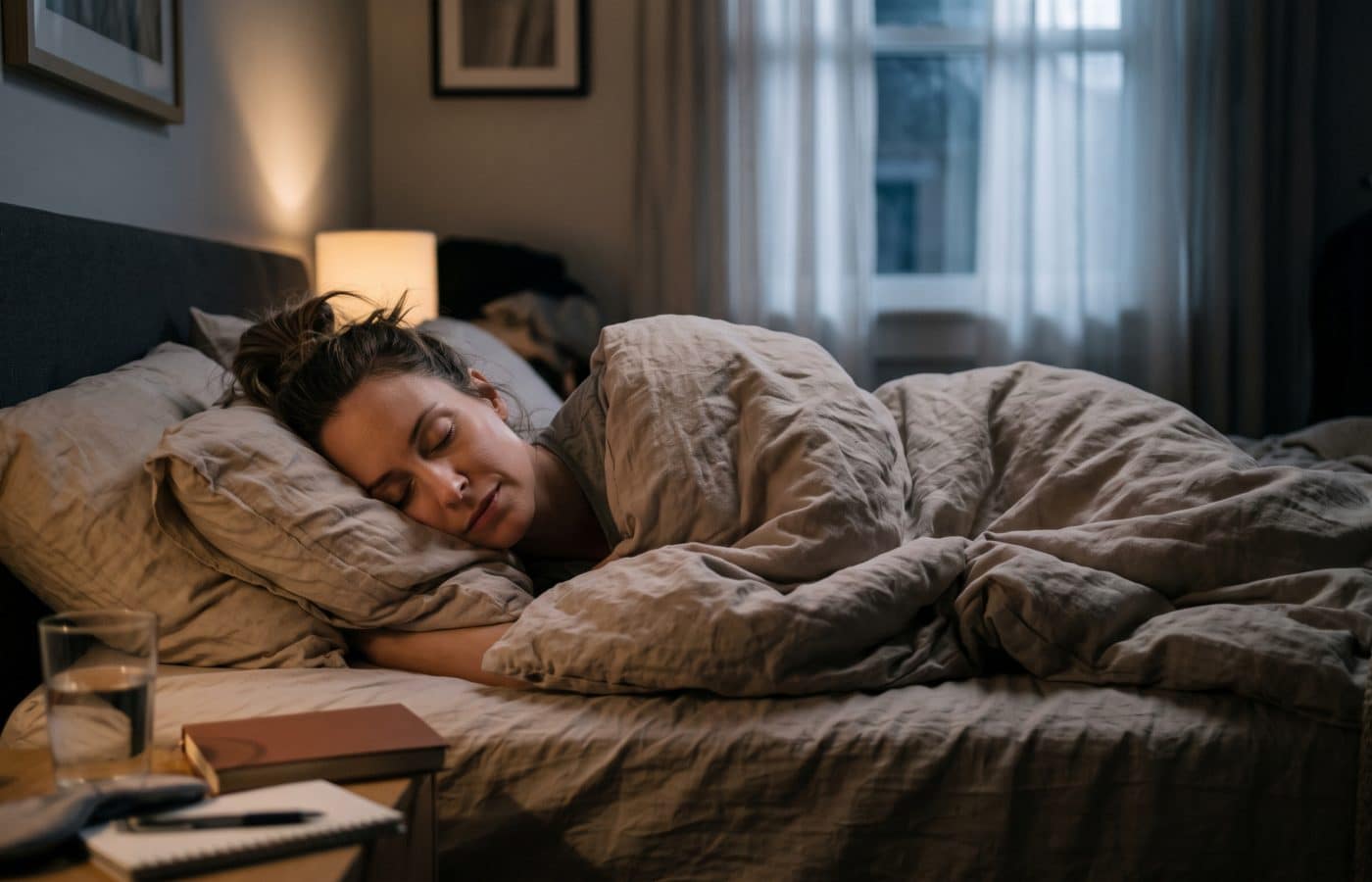
How to Fall Asleep Fast: Methods That Work on Restless Nights

Most people who search how to fall asleep fast are hoping for a trick. They want one breathing pattern or one supplement that flips a switch. After years of sitting across from patients who have tried everything, I can tell you the switch exists, but it isn’t where most people look. It lives in how you treat the bed, how you handle the thoughts that show up at lights out, and what your body temperature is doing in the hour before you lie down.
This guide is the version I give patients in person. It isn’t a list of fifty tips. It covers the handful of methods I have seen work again and again, with the research behind them, and the honest caveats I would want someone to give me.
First, What Does It Mean to Fall Asleep Fast?
Before we fix anything, we need a fair target. Healthy sleepers don’t drop off the second their head touches the pillow. In fact, falling asleep within a minute or two every night can be a sign you are seriously sleep deprived.
A realistic window is somewhere around 10 to 20 minutes. The Sleep Foundation’s guide to sleep latency puts a normal range in roughly that same 10 to 20 minute window. Clinicians call this stretch “sleep latency,” and the good news is that it is trainable.
So if you currently take 45 minutes and you get that down to 15, you have succeeded. You don’t need to become someone who sleeps like a dropped stone.
Why You Can’t Fall Asleep Fast on Restless Nights
When patients describe a bad night, they almost always describe the same thing. Their body feels tired, but their mind is wide awake. That mismatch has a name in sleep medicine: hyperarousal.
Three forces decide when you fall asleep:
- Sleep pressure. The longer you are awake, the more your brain builds up a drive to sleep. Naps, sleeping in, and going to bed too early all drain this pressure.
- Your body clock. Your circadian rhythm sets a window when sleep is easiest. Fight that window and sleep resists you.
- Arousal. Worry, frustration, excitement, and even the effort of trying to sleep keep your nervous system on alert.
On a restless night, the first two are usually fine. It’s the third one that is the problem. Nearly every method below works by lowering arousal, either in the mind or in the body. If daytime pressure is what keeps that alarm running, our guide on how to reduce stress covers practical tools that pair well with everything here. Medical conditions such as insomnia, sleep apnea, and restless legs syndrome can also get in the way of falling asleep, which is why I always include a section on when to get help.
Method 1: Get Out of Bed When You Can’t Fall Asleep Fast
This is the one patients push back on the most, and it is the one I trust the most.
If you have spent months lying awake, your brain has learned a bad lesson. It now links your bed with tossing, clock watching, and frustration. Every night you lie there fighting, you strengthen that link.
The fix comes from a clinical approach called stimulus control. It was developed by Richard Bootzin and is built on classical conditioning. The core rule is simple. If you don’t fall asleep within roughly 15 to 20 minutes, you leave the bed, do something calm in another room, and come back only when you feel sleepy.
How to Make Stimulus Control Work
A few details matter here:
- Don’t watch the clock. Checking the time to enforce the 15 to 20 minute rule is discouraged, so turn the clock away. Just estimate.
- Plan your out of bed activity ahead of time. Keep a dull book, a puzzle, or some light folding laundry ready in a dim room. No bright screens, no work email. Late-night inbox checks are also when tired eyes are most likely to miss the warning signs in our guide on how to spot phishing emails.
- Expect a rough first week. When people start, it’s common to get up several times before they finally fall asleep. That is the retraining happening.
This isn’t a fringe idea. The American Academy of Sleep Medicine’s 2021 guideline suggests stimulus control can work on its own to treat chronic insomnia in adults. If you share a bed or have mobility limits, there’s a gentler version. Called counter control, it means staying in bed but sitting up out of your sleeping position, without the pillow and blanket.
Method 2: The Cognitive Shuffle to Fall Asleep Fast With a Racing Mind
Some nights the problem isn’t worry exactly. It’s that your brain will not stop making sense of things. You replay a meeting, plan a holiday, solve a problem that doesn’t need solving at midnight.
Cognitive shuffling was designed for exactly this. It came from Luc Beaudoin, a cognitive scientist who had trouble sleeping in college and built a method that deliberately copies what the brain seems to do on its own as we drift off. He has observed that people woken during the transition into sleep often describe little fragments, almost micro dreams.
Here is how I teach it:
- Pick a simple, emotionally neutral word, such as “garden.”
- Take the first letter, G, and think of a word that starts with it: “guitar.”
- Picture that guitar for a few seconds. Its color, the strings, where it sits.
- Move on to another G word: “goat.” Picture it.
- When you run out of G words, move to the next letter in “garden,” which is A.
The key is that the words should have no connection to each other. Beaudoin advises against linking the words together. You want scrambled, dreamlike images, not a story.
Does the Cognitive Shuffle Work?
When Beaudoin tested it on college students against an evening journaling technique called constructive worry, the shuffle performed just as well, with the advantage that it needs no pen, paper, or worksheets. The research is still early, and I tell patients that honestly. Even so, sleep experts see the logic behind it, and it’s considered a good option for people who ruminate.
Method 3: Write Tomorrow’s Task List to Fall Asleep Fast
This one surprises people because it sounds like it should make worry worse. If you write down everything you have to do, won’t you lie there thinking about it?
The data says no. Researchers at Baylor University monitored 57 healthy adults aged 18 to 30 overnight in a sleep lab. Using polysomnography, they found that participants who wrote a to do list fell asleep about nine minutes faster on average than those who wrote about tasks they had already finished.
The specifics mattered too. The more detailed people made their to do list, the faster they fell asleep, while the opposite pattern appeared in those writing about completed activities.
How to Write Your Bedtime List
My version for patients:
- Spend five minutes, no more. Do it outside the bed, ideally at a desk or kitchen table.
- Be specific. “Call the dentist about the Thursday appointment” works better than “dentist.” The same goes for money and admin tasks: “Review this month’s grocery spending against my budget” or “Replace my old email password with a strong password” beats a vague “sort out finances.”
- Close the notebook and leave it in another room. The act of putting it down is part of the signal.
One honest limit: those volunteers were young and didn’t have sleep problems. The lead researcher himself noted that a larger study would be valuable and that anxiety and depression might change how well the effect holds. Still, it costs five minutes and a pen.
Method 4: Slow Your Exhale
Breathing techniques get oversold online. You’ll see claims that a specific count will knock you out in sixty seconds. I don’t promise that.
What I can say is that a slower exhale than inhale nudges your nervous system toward rest. It works through the vagus nerve, which helps govern your heart rate. When your out breath is longer, your heart rate tends to ease down with it.
A simple routine:
- Breathe in gently through your nose for a count of four.
- Hold for a moment if that feels comfortable.
- Breathe out slowly through your mouth for a count of six to eight.
- Repeat for a few minutes.
You may have read about the popular pattern of inhaling for four, holding for seven, and exhaling for eight. It’s fine to use, but if the long hold makes you feel tense or short of breath, drop it. The important part is the long, unhurried exhale. If counting itself starts to feel like a task, stop counting and simply let the out breath be longer than the in breath.
Method 5: Progressive Muscle Relaxation
Many people carry the day in their bodies without noticing it. Clenched jaw, raised shoulders, a tight stomach. You can’t fall asleep easily while your muscles are braced for action.
Progressive muscle relaxation works by tensing a muscle group for about five seconds, then releasing it and noticing the difference for about fifteen to twenty seconds. You move through the body in order:
- Feet and toes
- Calves
- Thighs
- Glutes and stomach
- Hands and forearms
- Upper arms and shoulders
- Face and jaw
The release is the important half. Pay attention to the warmth and heaviness that follows.
The evidence here is reassuringly solid. A 2026 systematic review and meta analysis of randomized controlled trials concluded that progressive muscle relaxation improves subjective sleep quality in adults. Interestingly, the improvements didn’t seem tied to how many sessions people completed. In practice, I find it helps most when you practice it a few times during the day first, so it feels familiar by bedtime.
Method 6: Stop Trying to Fall Asleep Fast
This is my favorite method to explain, because it sounds like a joke.
Sleep is one of the few things in life that gets harder the more effort you put in. You can’t force it. Every time you check whether you are asleep yet, you wake yourself up a little more.
Clinicians use a technique called paradoxical intention. The idea is to remove the pressure by doing the opposite: lie in bed with your eyes open and calmly tell yourself you aren’t going to fall asleep.
You aren’t fighting sleep. You are simply giving up the fight for it. Lie there, eyes gently open in the dark, and let yourself rest without any goal. For many of my patients who have performance anxiety around sleep, this is the moment things finally loosen.
Method 7: Take a Warm Shower About 90 Minutes Before Bed
This one works on your body clock rather than your thoughts, and it has some of the cleanest evidence of anything in this guide.
Your core body temperature naturally drops as bedtime approaches. About an hour and a half before your usual sleep time, your body cools by roughly 0.5 to 1 degree Fahrenheit. A warm bath or shower helps that drop along by drawing blood toward your hands and feet, where heat escapes.
Researchers at the University of Texas at Austin, working with UT Health Science Center at Houston and the University of Southern California, reviewed 5,322 studies and found that a bath scheduled one to two hours before bed can cut the time to fall asleep by an average of 10 minutes. According to Medical News Today’s coverage, the bath or shower doesn’t need to last longer than 10 minutes to get the benefit.
Timing matters. The lead researcher stressed that a warm bath just 15 minutes before bed is too soon to get the same effect. So aim for 60 to 120 minutes before you plan to sleep.
Method 8: Set Up the Room Like You Mean It
I am not going to tell you to buy a new mattress. But I will ask you to look honestly at three things in your bedroom.
Temperature. A cool room supports that natural drop in body temperature. Most people sleep best somewhere in the mid to high sixties Fahrenheit, around 18 to 20 degrees Celsius. If you wake up kicking off the covers, the room is probably too warm.
Light. Blue light from phones, tablets, and computers can interfere with melatonin production and make it harder to fall asleep. Dim the lights in the last hour, and if streetlights leak in, blackout curtains or an eye mask are worth the small cost.
The clock. I mentioned this earlier, but it deserves its own line. Turn your clock away from the bed. Nothing raises arousal faster than doing mental math at 2 a.m. about how many hours you have left.
Daytime Habits That Help You Fall Asleep Fast
A lot of the work of falling asleep fast happens hours before bed. I often tell patients that the night starts in the morning.
- Wake up at the same time every day. This is the single most useful habit for your body clock, including on weekends. A University of Massachusetts insomnia program notes that sleeping in on weekends is the main cause of what it calls Sunday night insomnia.
- Get morning light. Ten to twenty minutes outdoors soon after waking sets your internal clock and makes evening sleepiness arrive on time.
- Be careful with naps. The same program advises that naps of 45 minutes or less, taken no later than 3 p.m., are the safer kind. If you struggle at night, skip them entirely for a few weeks.
- Watch the caffeine clock. Caffeine lingers in your system for many hours. For most of my patients, a cutoff around early afternoon makes a real difference.
- Don’t count on alcohol. A drink may make you drowsy, but it fragments sleep later in the night. It is a poor trade.
Mistakes I See Over and Over
After enough years in this field, the same habits show up in almost every consultation. If you recognize yourself, you aren’t alone.
Going to bed early to “catch up.” This feels logical but backfires. Heading to bed early to get a head start on sleep actually makes insomnia worse rather than adding sleep. Go to bed when you are sleepy, not just tired.
Scrolling in bed “to relax.” The content keeps your mind engaged, and the bed starts to mean entertainment instead of sleep.
Lying in bed for hours hoping it will eventually happen. See Method 1. Staying there trains the wrong habit.
Treating one bad night as a crisis. Everyone has rough nights. Your body is good at recovering. Panic about one bad night is often what causes the second.
A Simple Plan to Fall Asleep Fast on Your Next Restless Night
Patients often ask me to put it all together. Here is the sequence I suggest.
- Two hours before bed: Finish heavy meals and work. Lower the lights in the house. If you run your own business or are working through how to start an LLC, set a firm end time, since self-employed work rarely stops on its own.
- Ninety minutes before bed: Take a warm shower or bath for about 10 minutes.
- One hour before bed: Put the phone on charge outside the bedroom. Write tomorrow’s task list for five minutes.
- In bed: Do a short round of progressive muscle relaxation, then a few minutes of slow, long exhales.
- When your mind starts racing: Switch to the cognitive shuffle.
- If you are still awake after what feels like 20 minutes: Get up, go to a dim room, do something dull, and come back when sleepy.
- Straining to sleep? Open your eyes, rest, and let go of the goal.
- Next morning: Get up at your usual time, no matter how the night went, and get outside into daylight.
Don’t expect all of this to click on the first night. Behavioral sleep methods are skills. They usually take one to three weeks of steady practice before the change becomes obvious.
When to Talk to a Professional
Self help has limits, and I would be doing you a disservice if I didn’t say so.
Please see a doctor or a sleep specialist if:
- You struggle to fall or stay asleep at least three nights a week for three months or more.
- Someone has told you that you snore loudly, gasp, or stop breathing in your sleep.
- You feel an uncomfortable urge to move your legs in the evening.
- Daytime sleepiness affects your driving, work, or mood.
- Low mood or anxiety are a big part of your sleepless nights.
For chronic insomnia, the gold standard is cognitive behavioral therapy for insomnia, often shortened to CBTI. The American Academy of Sleep Medicine, the European Sleep Research Society, and the Canadian Sleep Society all recommend it as the first treatment for chronic insomnia, ahead of medication. Many of the methods in this article are pieces of that program. A trained clinician can tailor them to you, and the results often last far longer than sleeping pills.
Frequently Asked Questions About How to Fall Asleep Fast
How long should it take a healthy adult to fall asleep?
Usually somewhere between 10 and 20 minutes. Taking a little longer now and then is normal. Falling asleep instantly every single night may actually point to sleep deprivation. The Sleep Foundation’s overview of sleep latency explains this in more detail.
What should I do if I can’t sleep after 20 minutes?
Get out of bed and do something quiet and dull in dim light, then return when you feel sleepy. This is the core of stimulus control, explained well in this overview of stimulus control therapy from Rise Science.
Does the cognitive shuffle really work?
Early studies are promising, and it seems to work about as well as other cognitive techniques it has been tested against. It’s especially useful for people whose minds race at night. You can read more in Psychology Today’s piece on cognitive shuffling.
Is writing a to do list before bed better than journaling?
In the Baylor study, writing a specific to do list helped people fall asleep faster than writing about tasks they had already finished. See the Baylor University summary of the research.
Can a warm shower help you fall asleep fast?
Yes, if the timing is right. About one to two hours before bed works best, with around 90 minutes being the sweet spot. Showering right before bed is too late to get the full benefit. Medical News Today covers the UT Austin findings.
Do relaxation exercises help you fall asleep fast?
They help lower the tension that keeps you awake. A recent meta analysis found that progressive muscle relaxation improves sleep quality in adults. The full review is available through the National Library of Medicine.
Should I take sleeping pills to get to sleep sooner?
For chronic trouble, behavioral treatment is recommended first, and medication decisions belong with your doctor. Talk to a clinician before starting any sleep aid, including over the counter ones.
References
- Sleep Foundation. Sleep Latency and Strategies for Better Sleep Onset
- Rise Science. Stimulus Control Therapy: The Six Rules That Make Your Bed Mean Sleep
- Sleepspace. Stimulus Control: Associating Your Bed with Sleeping
- UMass Chan Medical School. Overcoming Insomnia, Session 2: Sleep Scheduling and Stimulus Control
- American Academy of Sleep Medicine. Behavioral and Psychological Treatments for Chronic Insomnia Disorder in Adults
- Psychology Today. A Creatively Random Idea for Falling Asleep
- Boston Globe. Have Trouble Falling or Staying Asleep? Try Cognitive Shuffling
- Oprah.com. The Trick That Helps You Fall Asleep
- Baylor University. Baylor Research on Bedtime To Do Lists
- Sleep Review. Bedtime To Do Lists and Sleep Onset in Young Adults
- Medical News Today. Warm Bath or Shower Timing for Better Sleep
- CBS News. A Hot Bath 1 or 2 Hours Before Bedtime Can Improve Your Sleep
- Healthline. Having Trouble Sleeping? Try a Hot Bath Before Bed
- Frontiers in Public Health via National Library of Medicine. The Effects of Progressive Muscle Relaxation on Sleep Quality in Adults: A Systematic Review and Meta Analysis